


What is Due Dilligence
You need to know about this subject if you are a Start-up entrepreneur. Investors may request to conduct due diligence on a company...

Noreen Hynes

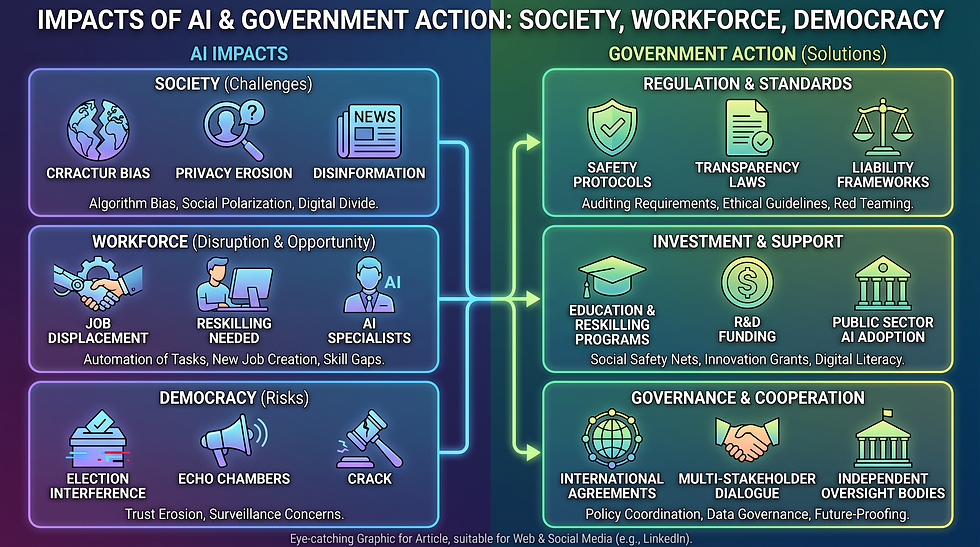
We're at the brink of something unprecedented—not just another industrial revolution, but a fundamental rethinking of work itself. Research institutions indicate that we have about eight years to get this right. Eight years to answer questions that will determine whether AI becomes humanity's most excellent tool or its biggest crisis. People are concerned, and so should their political representatives. According to the Pew Research Center, a median of 34% of adults across 25 countries are more concerned than excited about the increased use of artificial intelligence in daily life. A median of 42% are equally concerned and excited, and 16% are more excited than concerned.(1)
The Scale of Disruption: What the Experts SayBill Gates has been quite candid about what lies ahead. In February 2025, he predicted that in the next decade, humans will no longer be needed "for most things" in the world, as expertise once thought rare will become "free, commonplace" through AI (2).
Geoffrey Hinton, the 78-year-old Nobel Prize-winning "Godfather of AI," warns even more starkly: "For mundane intellectual labor, AI is just going to replace everybody. You'd have to be very skilled to have a job that it couldn't just do" (3).
The numbers support this. The World Economic Forum projects that by 2030, 92 million jobs will be lost but 170 million new ones will be created—resulting in a net gain of 78 million jobs [3]. However, Goldman Sachs estimates that 6-7% of the U.S. workforce could face displacement, potentially impacting 300 million jobs worldwide (4). McKinsey warns that between 400 and 800 million people globally may need new jobs by 2030, with 75 to 375 million requiring complete changes in their occupational categories (6).
We're already seeing this: unemployment among 20-30-year-olds in tech-exposed occupations has risen by three percentage points since early 2025 [4]. Graduate hires at Meta and Google dropped 25% from 2023 to 2024. Major banks and law firms have cut entry-level hiring by up to 25%.
Hinton's assessment is blunt: "Rich people are going to use AI to replace workers. It's going to create massive unemployment and a huge rise in profits. That's not AI's fault, that is the capitalist system" (7).
As time goes on, we will observe how trends change and how quickly AI advances. It is still unclear how many jobs will be lost and what those losses will mean, but we know so far that the impact will be significant and will require immediate action. Doing nothing is not an option for governments. They have a duty to recognize when a seismic shift is happening, and early action is essential. How many of your friends and family have lost their jobs in the past year? They need to learn how to work alongside AI in order to get back to work.
The Purchasing Power Paradox and Wealth Concentration
If robots replace millions of workers, who will have money to buy what robots produce? This isn't hypothetical—it's basic economics with catastrophic potential. AI is creating wealth at unprecedented speed; 29 AI founders accumulated $71 billion in 2025 alone (8). Meanwhile, AI-driven productivity gains favor high-income workers, intensifying inequality (9).
This creates a "demand crisis"—when large groups lack the ability to buy, the economy stalls regardless of how efficient production is. About 50-70% of the growth in wage inequality over the last 40 years can be linked to automation technologies (9). AI risks accelerating this process significantly, leaving nothing to replace the income of those who have lost their jobs. This is not like the Industrial Revolution because the pace of change is so fast in months rather than years.
Democracy, Governance, and Taxation Systems
Keeping Democracy Intact
Democracy faces both threats and opportunities from AI. The threats include the collapse of the information ecosystem through AI-generated misinformation, enhanced surveillance capabilities, unprecedented wealth concentration (San Francisco now has 82 billionaires compared to New York's 66 (8), and reduced civic engagement due to economic stress. However, AI can also improve government services, enhance policy analysis, increase transparency, and foster better democratic participation.
California passed SB 53 in 2025, the first U.S. law requiring AI transparency and safety incident reporting [9]. Globally, mentions of AI legislation increased by 21.3% across 75 countries, with U.S. agencies introducing 59 AI regulations in 2024—twice the number introduced the previous year (11). The EU has also adopted the EU AI Act (Regulation (EU) 2024/1689), so progress is happening in this area.
Essential Taxation Reforms
As AI transforms our economy, tax systems must evolve to capture value increasingly created through automation rather than human labor (12). Here's a possible framework:
Progressive Automation Tax: Companies deploying AI that replaces human labor should pay a 15-25% tax on salary savings, collected quarterly. Revenue funds worker transition programs and universal basic income (13).
Enhanced Capital Gains: Tiered structure—35-40% for short-term gains (under 1 year), 25-30% medium-term (1-5 years), 20% long-term (over 5 years).
Digital Services Tax: 3-5% tax on gross digital services revenue to counter international tax avoidance schemes (12)
Wealth Tax: Annual tax on ultra-high net worth individuals—2% on $50M-$500M, 3% on $500M-$1B, 4% above $1B—addressing wealth concentration, especially from AI.
Data Value Tax: 5-10% of revenue from data monetization, recognizing users' contribution to AI development.
How AI Assists Tax Collection: AI enables fraud detection through pattern recognition, automates compliance checking, provides real-time monitoring (Singapore's virtual assistant cut call-center inquiries by half (14), and conducts sophisticated risk assessments. The IRS has expanded its Direct File program using AI for document recognition and data extraction (15).
Government Preparedness and AI Leverage
Most governments are woefully unprepared. Only 1% of organizations, including government agencies, consider themselves "mature" in AI deployment (16). Over 14,000 government employees from 200 organizations registered for 2024 AI training, revealing massive knowledge gaps (17).
Critical Skills Governments Need Now:
AI Policy Specialists bridging technical capabilities and policy implications
Data Scientists and ML Engineers to audit private sector AI systems ( will depend on the government's involvement in the Tax collection processes)
Digital Transformation Officers experienced in large-scale tech change
Workforce Transition Specialists designing retraining programs
AI Ethics and Rights Officers preventing bias and civil rights violations
Cross-Functional "Translators" connecting policy silos
Government AI Strategy
Deploy AI internally first, enhance service delivery (automated document processing, multilingual support, fraud prevention), enable evidence-based policymaking, and implement predictive resource allocation.
Action Timeline
Months 1-6: Create AI readiness task forces with Chief AI Officers at every agency.
Months 6-18: Rapid upskilling programs making AI literacy mandatory for managers.
Year 1-2: Reform procurement processes for faster AI acquisition.
Year 1-3: Establish regulatory sandboxes for safe testing.
Ongoing: Cross-sector partnerships with universities, tech companies, unions, and communities.
Experts warn we have an 18-month window before AI impacts become irreversible (19).
Universal Basic Income and Government Equity Stakes
Pilot programs show UBI works. A 2024 study giving 1,000 low-income participants $1,000 monthly (a 40% income increase) found that money went to essentials—retail/services, food (32%), transport, and housing (9% each). People didn't quit working or waste funds (20). Wales' £ 1,600-monthly pilot improved mental health and enabled educational pursuits (21).
Recommendation: Start with a living wage covering necessities, add participation bonuses for education/training/community service, and adjust regionally for cost differences.
Government Equity Stakes
The U.S. took a 10% stake in Intel for $8.9 billion under the CHIPS Act (21). This model should expand:
Tier 1: Companies developing advanced AI systems should offer the government a minimum equity stake of 20%.
Tier 2: Mass-automation deployers should contribute to sovereign wealth funds.
Tier 3: Critical infrastructure AI systems suppliers should have mandatory Government representation on their boards.
Revenue flows to citizen wealth funds, such as Alaska's Permanent Fund, which pays residents $1,000-$2,000 annually since 1982 (21).
The Future of Work and Human Purpose
Work isn't disappearing—it's transforming. The demand for health professionals and STEM workers is expected to grow by 17-30% by 2030 (22). Hinton notes healthcare's elastic demand: making doctors five times more efficient means five times more healthcare, not fewer doctors [(3).
Jobs AI Struggles to Replace:
Care Work: Face-to-face human interaction for eldercare, childcare, therapy, and teaching. "There's something about the human empathy aspect that's particularly humanistic," says DeepMind CEO Demis Hassabis (3).
Creative Problem-Solving: Requiring intuition and cultural understanding.
Relationship Building: Community organizing, mediation, mentoring.
Skilled Trades: Electricians, plumbers, mechanics, facing unpredictable physical problems.
Gates identifies three relatively safe professions: coders (to correct AI errors), energy experts (to manage AI infrastructure), and biologists (for creative research) [1]. Even NVIDIA's CEO suggests that youth explore biology, education, or farming rather than software engineering.
Education, Motivation, and Inequality
Educational Transformation
Our industrial-era education model is obsolete. Two-thirds of countries now offer K-12 computer science education (double the number since 2019), and U.S. computing degrees increased by 22% (11).
Four Essential Pillars:
Learning how to learn (skills have shorter half-lives)
Human-AI collaboration (providing judgment and oversight)
Interdisciplinary synthesis (connecting ideas across domains)
Emotional and social intelligence (empathy, communication, collaboration)
Implementation: Project-based learning, lifelong learning accounts with periodic stipends, stackable micro-credentials, and free community college with AI-powered personalization.
Addressing the Laziness Myth
Evidence from 150 U.S. unconditional cash experiments: people pay bills, secure food, then plan their financial future [22]. Kenya's UBI pilot found recipients were less prone to food insecurity, had better health, and were motivated to start businesses (21).
Hinton warns that UBI alone "won't deal with human dignity" and the value of work (7), but this emphasizes recognizing non-market labor (such as caregiving, volunteering, and art) as legitimate work, rather than opposing financial security.
Wealth Inequality and the Middle Class
Unless we intervene, the wealthy will continue to get wealthier. AI demands huge amounts of capital—those with capital invest, capture gains, and build wealth over time. Those who do not provide data (i.e., unpaid) will lose their jobs. Approximately 375 million workers (14% globally) will need retraining by 2030 (6).
Morgan Stanley laid off 2,000 employees in March 2025 to replace them with AI. Bloomberg Intelligence projects 200,000 job cuts at banks. Traditional middle-class entry points are disappearing.
Solutions: Guaranteed government support for reeducation, profit-sharing mandates, housing as a right, universal healthcare decoupled from employment, and comprehensive retraining programs.
The Paycheck-to-Paycheck Crisis
For 60% of Americans who cannot cover a $1,000 emergency, AI displacement presents a real threat. Goldman Sachs estimates unemployment could increase by half a percentage point during the transition (5). Even a few weeks of unemployment can lead to eviction or hunger.
Immediate protections include: Emergency income insurance (automatic payments upon job loss), rapid retraining with living stipends, portable benefits, debt-jubilee provisions for displaced workers, and housing-stability programs that prevent evictions.
The Path Forward
Years 1-2
Emergency income insurance, extensive retraining with stipends, UBI pilots, citizen wealth funds, AI readiness task forces, government workforce upskilling, progressive automation taxation.
Years 3-5
Government equity stakes in AI companies, full implementation of tax reform, universal capital accounts, an overhaul of the education system, restructuring of labor laws, and scaled-up government AI deployment.
Years 6-8
Full UBI implementation, recognition of non-market work, democratic AI oversight, and global coordination on AI governance.
Essential Principles
Upholding human dignity regardless of productivity, ensuring democratic control over AI's societal impact, promoting equitable distribution of benefits, and supporting ongoing adaptation.
The Choice Before Us
Hinton has expressed regret: "A part of me now regrets my life's work. I console myself with the usual excuse: If I hadn't done it, somebody else would have." He estimates a 10-20% chance that AI poses existential threats (7).
Gates remains optimistic about "breakthrough treatments for deadly diseases, innovative solutions for climate change, and high-quality education for everyone" (2), while acknowledging humans won't be needed "for most things" within a decade.
The future isn't predetermined. We can choose a world where AI amplifies inequality and a techno-aristocracy dominates, or one where AI liberates humans from drudgery and prosperity is shared. We have approximately 18 months to make crucial decisions and 8 years to fundamentally restructure our systems (19).
We've split the atom, walked on the moon, and connected the world through invisible networks. We can handle this, too. The AI revolution will be what we make of it—not what algorithms decide, or billionaires want, but what we, together, choose to build. Noreen Hynes B. COMM, FCA
References
https://www.pewresearch.org/2025/10/15/concern-and-excitement-about-ai/
CNBC. (2025, March 26). Bill Gates: Within 10 years, AI will replace many doctors and teachers—humans won't be needed 'for most things'. https://www.cnbc.com/2025/03/26/bill-gates-on-ai-humans-wont-be-needed-for-most-things.html
Fortune. (2025, June 17). The 'Godfather of AI' says this sector will be safe from being replaced by tech—but even then, only the 'very skilled' will hold down a job. https://fortune.com/2025/06/17/godfather-of-ai-google-geoffery-hinton-tech-job-wipeout-healthcare-anthropic-deepmind/
The Interview Guys. (2025, August 21). The state of AI in the workplace in 2025: Why 170 million new jobs will offset the 'AI apocalypse'. https://blog.theinterviewguys.com/the-state-of-ai-in-the-workplace-in-2025/
Briggs, J. (2025, August 13). How will AI affect the global workforce? Goldman Sachs. https://www.goldmansachs.com/insights/articles/how-will-ai-affect-the-global-workforce
Manyika, J., Lund, S., Chui, M., Bughin, J., Woetzel, J., Batra, P., Ko, R., & Sanghvi, S. (2017, November 28). Jobs lost, jobs gained: What the future of work will mean for jobs, skills, and wages. McKinsey Global Institute. https://www.mckinsey.com/featured-insights/future-of-work/jobs-lost-jobs-gained-what-the-future-of-work-will-mean-for-jobs-skills-and-wages
Fortune. (2025, September 6). Geoffrey Hinton says AI will cause massive unemployment and send profits soaring. https://fortune.com/2025/09/06/godfather-of-ai-geoffrey-hinton-massive-unemployment-soaring-profits-capitalist-system/
Franck, T. (2025, August 10). AI is creating new billionaires at a record pace. CNBC. https://www.cnbc.com/2025/08/10/ai-artificial-intelligence-billionaires-wealth.html
Kurzman, E., Autor, D., & Acemoglu, D. (2024, July 9). AI's impact on income inequality in the US. Brookings Institution. https://www.brookings.edu/articles/ais-impact-on-income-inequality-in-the-us/
Cameron, H. (2025, September 29). Newsom signs California bill regulating AI companies into law. NBC News. https://www.nbcnews.com/tech/tech-news/ai-law-california-ca-companies-regulation-newsom-rcna234562
Stanford Institute for Human-Centered Artificial Intelligence. (2025). The 2025 AI index report. https://hai.stanford.edu/ai-index/2025-ai-index-report
Bastani, S., & Waldenström, D. (2024, September 29). AI and automation: How should we tax the future? IZA Institute of Labor Economics. https://newsroom.iza.org/en/archive/research/ai-and-automation-how-should-we-tax-the-future/
Ahmed, S. (2024, May 15). Navigating the future of work: A case for a robot tax in the age of AI. Brookings Institution. https://www.brookings.edu/articles/navigating-the-future-of-work-a-case-for-a-robot-tax-in-the-age-of-ai/
Hakobyan, M., & Khemani, S. (2025, February 25). How AI can help both tax collectors and taxpayers. International Monetary Fund Blog. https://www.imf.org/en/Blogs/Articles/2025/02/25/how-ai-can-help-both-the-taxman-and-the-taxpayer
FileLater. (2025, February 26). Tax preparation in 2025: Embracing tax technology and AI innovations. https://www.filelater.com/resources/tax-preparation-in-2025-embracing-tax-technology-and-ai-innovations/
McKinsey & Company. (2025, January 28). AI in the workplace: A report for 2025. https://www.mckinsey.com/capabilities/mckinsey-digital/our-insights/superagency-in-the-workplace-empowering-people-to-unlock-ais-full-potential-at-work
U.S. General Services Administration. (2025, February 18). Empowering responsible AI: How expanded AI training is preparing the government workforce. https://www.gsa.gov/blog/2024/12/04/empowering-responsible-ai-how-expanded-ai-training-is-preparing-the-government-workforce
The White House. (2025, July). Winning the race: America's AI action plan. https://www.whitehouse.gov/wp-content/uploads/2025/07/Americas-AI-Action-Plan.pdf
Kuehn, D., & Gundersen, C. (2025, April 2). How government can embrace AI and workers. Urban Institute. https://www.urban.org/urban-wire/how-government-can-embrace-ai-and-workers
Gandel, S. (2024, July 22). UBI study backed by OpenAI's Sam Altman bolsters support for basic income. Bloomberg. https://www.bloomberg.com/news/articles/2024-07-22/ubi-study-backed-by-openai-s-sam-altman-bolsters-support-for-basic-income
Wikipedia. (2025, August 4). Universal basic income pilots. https://en.wikipedia.org/wiki/Universal_basic_income_pilots
Manyika, J., et al. (2024, May 21). A new future of work: The race to deploy AI and raise skills in Europe and beyond. McKinsey Global Institute. https://www.mckinsey.com/mgi/our-research/a-new-future-of-work-the-race-to-deploy-ai-and-raise-skills-in-europe-and-beyond
West, S., & Dearing, M. (2024, August 19). The results are in on America's largest universal income experiment. WBUR. https://www.wbur.org/onpoint/2024/08/19/universal-guaranteed-income-experiment-economy
Comments