top of page

Budgeting for Your 20s: The System That Actually Works (Because You're Not Broken)

  • Writer: Noreen Hynes
    Noreen Hynes
  • May 28
  • 9 min read

Updated: Jun 13


By Noreen Hynes, B.Comm, FCA | Chartered Accountant, Author of Rich Start

A graphic with blacl background and green and yellow headed Your Not Bad with money, Budgeting for your 20's, a picture of a  broken pig with a mobile phone and an upward arrow.
Choose the system that suits your personality.

Budgeting in Your 20's

Budgeting in your 20s is not supposed to feel this hard—and if it does, you are not the problem. If budgeting feels impossible, you were not bad with money. You were just handed a broken system and told to figure it out.

Your generation inherited a financial landscape completely different from what your parents faced. You are managing money through apps they never used, juggling gig income they never considered, and dealing with subscription services that did not exist when traditional budgeting advice was written. Yet the advice stays the same: track every dollar, deny yourself every bit of fun, and somehow find motivation in spreadsheets.

No wonder it does not work.

But here is what does work: a budget system built for how you actually live in your 20s. Not how some 1960s financial expert thinks you should live.

The Real Problem Isn't Your Spending

Your generation is facing a financial crisis, and it is not a personal failing. According to Deloitte's 2025 global survey of more than 23,000 Gen Z and millennial respondents across 44 countries, 48% of Gen Zs say they do not feel financially secure — a sharp rise from 30% in 2024 (1).

Read that again. Nearly half of your peers do not feel financially secure, and the number jumped 18 percentage points in a single year.

Dark blue finance infographic with cracked piggy bank and phone; text says Gen Z faces financial pressure and 48% feel insecure.
Take action now to banish financial stress.

This is not an individual failure. This is systemic. You were not taught personal finance in school. You graduated into an economy where housing, education, and healthcare costs have skyrocketed while wages have not kept pace. You are expected to navigate complex financial decisions — retirement accounts, investment options, and credit building — with zero formal education on any of it.

The good news? When you understand the systems and have the right infrastructure in place, the anxiety drops. This is not about willpower or discipline. It is about structure.

Why Traditional Budgets Fail You

Most budgets fail because they are built on restrictions instead of reality. They tell you to allocate $200 for groceries when you actually spend $380. They demand you track 25 different categories when you can barely remember to check your bank balance. They frame every coffee as a moral failure.

The result? You feel guilty, overwhelmed, and broke — even when you are trying.

The alternative is not trying harder. It is choosing a different container.

The Emma Breakthrough: Same Income, Different Life

Emma graduated with $28,000 in student loans and landed a $52,000 job. Her first month? Disaster. She had no system — just good intentions about being careful. Result: -$110 in the red, $35 overdraft fee, and complete confusion about where her money went.

Months two and three, she tried the detailed approach. Twenty-three budget categories. Manual tracking for every purchase. She lasted three weeks before abandoning the app, feeling like a failure.

Then Emma tried something different: the 50/30/20 rule with three separate bank accounts. 50% of her paycheck was automatically deposited into a "needs" account for bills. 30%  went to a "wants" account — her only debit card. 20% went straight to savings with no card access.

Her one rule: "When my wants account hits $200, I'm done spending for the month."

Within six months, Emma had $3,900 saved, her student loan balance was down by $800, her credit score had increased by 28 points, and her money stress vanished. Same salary. Same city. Same life. Different structure.

A year later, she had a $4,500 emergency fund and zero money anxiety. Her words: "I thought I was bad with money. I just needed the right container."

a graphic titles Your Not Bad With Money and a picture of a broken pig with a mobile phone with a graphic of a upward arrow, four squares each with a message  Your generation is under financial pressure, 3 silent money drains, pick one budgeting method and your generations secret weapon
Save this graphic — your complete budgeting system at a glance

Which Budgeting Method Actually Works for You?

Here is what the traditional advice misses: you do not need willpower. You need infrastructure.

Behavioral economics research proves that automatic enrollment in 401(k) plans dramatically increases participation compared to requiring employees to opt in manually (2). Your brain is not wired to resist immediate pleasure for future benefit — that is hyperbolic discounting at work. Fighting your neurology is exhausting. Building a system that works with your brain is effortless.

The four methods that actually work for budgeting in your 20s:

Pay Yourself First: Automate 5–10% of your pay to savings before you see it. Live on what remains. Start small — even $50 per paycheck matters more than you think.

Envelope Method: The envelope method assigns a fixed amount of money to each spending category — when the envelope is empty, spending in that category stops for the month. Divide spending into 3–5 categories (not 25). Free apps like Goodbudget digitize this without cash — 20 envelopes on the free plan, no bank switching required, available on iPhone, Android, and web.

50/30/20 Rule: The 50/30/20 rule divides your take-home pay into three categories: 50% for essential needs (such as rent and bills), 30% for wants (such as dining and entertainment), and 20% for financial goals (such as savings, debt repayment, and investing). Emma's method. Flexible, forgiving, and it works with real life.

Zero-Based Budgeting: Assign every dollar a job. Best for detail-oriented minds who want full control. Requires weekly attention but provides complete clarity.

Pick One. Not the "perfect" one — the one that fits your personality. Then stick with it for at least three months before evaluating. Switching methods every few weeks is just chaos disguised as optimization.

A graphic with a black background and green with white pront headed The Four Budgeting Methods, Pay Yourself First, 50/30/20 Envelop method, zero based with www.noreenhynes.com/rich-start at the bottom
Keep things simple, starting off, and stay with the chosen system for 3 months.

The Three Budget Killers Nobody Warns You About

1. Subscription Creep

According to Savanta's 2024 research, conducted in partnership with Minna Technologies and FT Strategies, the average U.S. consumer has 8.2 subscriptions, with Gen Z and millennials aged 18–44 averaging 8.4 each (3). And younger consumers are more likely than older ones to have increased their subscription spending in the past year.

To illustrate what this looks like in real life: Emma was paying $1,911 per year for subscriptions, but was only actively using $498 of them. That is $1,413 in annual waste — $118 per month vanishing into services she forgot existed. A quarterly subscription audit would have caught it immediately.

Your turn: Set a calendar reminder right now titled "Quarterly Subscription Audit." List everything with annual costs. Cancel anything you have not used in 30 days. Takes 15 minutes. Saves hundreds.

2. Convenience Spending

That $20 DoorDash meal actually costs $33 after fees, tip, and upcharges. One week of convenience spending — delivery meals, rideshares, Instacart — easily adds up to $232. Multiply that by 52 weeks, and you are looking at over $12,012 annually on services that deliver the same food you could get yourself.

The fix is not eliminating convenience completely. It is treating it as the luxury it is: 1–2 times monthly, not daily default.

3. Social Pressure

Your friends suggest $40 dinners, $85 concert tickets, and $300 weekend trips. Saying yes destroys your budget. Saying "I can't afford it" feels humiliating.

Try these scripts instead:

"I'm trying to spend less on restaurants this month, but I'd love to hang out. Want to do a picnic instead?"

"That sounds fun, but I'm focusing on paying down student loans right now. Let's plan something local soon?"

"I'll come for one drink, but I'm not staying for a full night — early morning tomorrow."

Real friends adapt. The ones who do not respect your boundaries? Let them go.

Review your subscriptions regularly, stop the drain.

What Is Loud Budgeting and Why Does It Work?

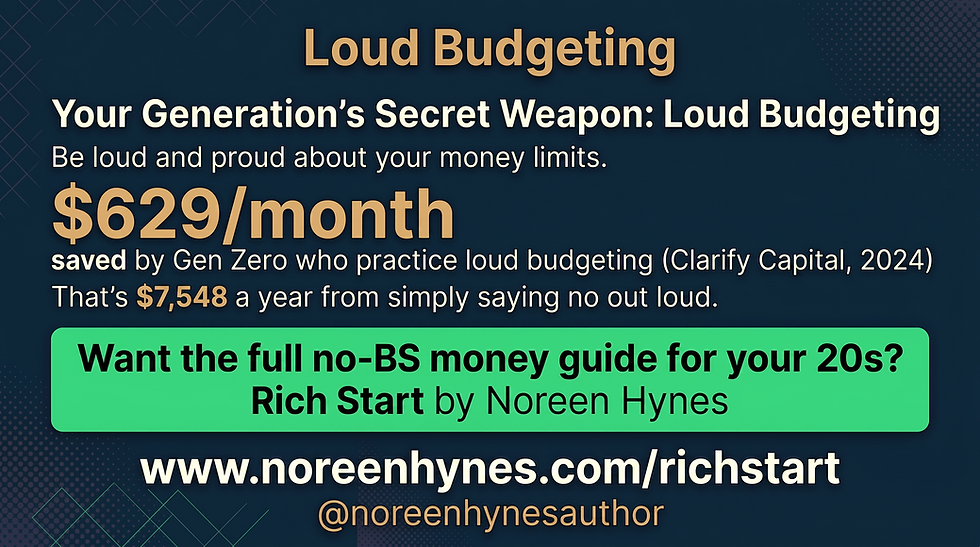
Loud budgeting is the practice of openly stating your financial limits without apology or shame. Instead of making excuses or pretending you cannot attend social events, you clearly and confidently state that you are choosing not to spend. It is a mindset shift from financial secrecy to financial empowerment — and it is uniquely powerful for your generation.

According to Clarify Capital's February 2024 survey of 1,020 Gen Z respondents, just 6% describe themselves as loud budgeters—but those who do save an average of $629 per month (4). That is $7,548 annually, simply from being transparent about money limits. Among Gen Z loud budgeters, 57% report reduced financial stress and 52% report increased financial empowerment.

Your generation is shifting the conversation from shame-based secrecy to empowered transparency. That is powerful. Use it.

How Do You Start Budgeting? Your First Month, Week by Week

Week 1: Download 60 days of bank statements. Calculate total fixed expenses. Calculate the average variable spending. Pick one method from this article.

Week 2: Set up infrastructure. Open additional accounts if needed. Automate what you can. Track spending without changing behavior — just watch where money goes.

Week 3: Make one reduction in your biggest problem category. Apply the 24-hour rule for any unplanned purchase over $50.

Week 4: Review the full month. Adjust category amounts to match reality (not ideal). Cancel identified subscription waste. Set the Month 2 budget using this month's real data.

The Truth About Perfection

You will have bad months. Expect 2–3 rough months in the first six. One failed month does not erase progress. It is not a test you pass or fail — it is a skill you are building.

The person making $75,000 with intentional systems often builds more wealth than the person making $125,000 without them. Control the outflow, and you unlock the surplus that transforms income into actual wealth.

Smart spending is not a restriction. It is control, clarity, and choice. When you know where money goes, automate the basics, and reduce the quiet leaks, stress drops, and options expand.

Emma proved it: same salary, different structure, completely different life.

A Note From the Author

I practiced the Pay Yourself First system throughout my entire working life — and I still do today.

I never spent a bonus. I never spent a windfall gain. Every extra dollar went straight into savings and investments for the future, without a second thought.

I never owned a new car, even though I could have easily bought one. I never upgraded my lifestyle just because my income increased. And I never once felt deprived.

What I felt was free.

That discipline — and it becomes less like discipline and more like a habit over time — gave me the option to pivot my career and become an entrepreneur, and eventually retire early. Not because I earned more than everyone else. Because I never inflated my spending to match what I earned.

That is the quiet secret behind every person who achieves financial independence. They did not find a shortcut. They just never changed their lifestyle when the money arrived.

You are starting earlier than I did. That makes your position even stronger than mine was.

Your turn.

Don't be afraid to say no and find the best way to say it.

Frequently Asked Questions

What is the best budgeting method for beginners in their 20s? The 50/30/20 rule is the most practical starting point for most people in their 20s. It requires only three categories — needs, wants, and financial goals — and works with separate bank accounts to create automatic boundaries without manual tracking. It is flexible enough to accommodate irregular income and forgiving enough to survive imperfect months.

What is the 50/30/20 rule? The 50/30/20 rule divides your take-home pay into three categories: 50% for essential needs such as rent, utilities, and groceries; 30% for wants such as dining out, subscriptions, and entertainment; and 20% for financial goals, including savings, emergency funds, debt repayment, and investing. It is one of the most widely recommended personal finance frameworks for young adults.

What is loud budgeting? Loud budgeting is the practice of openly stating your financial limits without apology or shame. Rather than inventing excuses or avoiding social situations, you directly state that you are choosing not to spend. A Clarify Capital survey of 1,020 Gen Zers found that those who practice loud budgeting save an average of $629 per month and report significantly reduced financial stress (4).

Why do most budgets fail? Most budgets fail because they are built on restriction rather than reality, set targets based on ideal spending rather than actual spending, and require consistent willpower rather than automated systems. A budget that removes the need for willpower — through automation and separate accounts — removes the primary reason most budgets fail.

How do I budget when I have student loans? Include your minimum student loan payment as a fixed need inside your 50% category. Once your emergency fund reaches $1,000, redirect additional savings towards accelerated loan repayment. Do not sacrifice your emergency fund to pay loans faster — an unexpected expense without a buffer will push you straight back into higher-cost debt.

How much should I save in my 20s? Start with whatever you can automate — even $50 per paycheck builds the habit and the system. The priority in your early 20s is not the amount; it is establishing the infrastructure that makes saving automatic. Contributions grow naturally as income increases, but only if the system is already in place.

References:

(1) Deloitte. (2025, May 14). Deloitte Global's 2025 Gen Z and Millennial Survey finds these generations focused on growth as they seek money, meaning, and well-being [Press release]. https://www.deloitte.com/global/en/about/press-room/deloitte-2025-gen-z-and-millennial-survey.html

(2) Madrian, B. C., & Shea, D. F. (2001). The power of suggestion: Inertia in 401(k) participation and savings behavior. The Quarterly Journal of Economics, 116(4), 1149–1187. https://doi.org/10.1162/003355301753265543

(3) Savanta. (2024, August 2). Gen Z and Millennials: Shaping the subscription economy. https://savanta.com/knowledge-centre/view/gen-z-and-millennials-shaping-the-subscription-economy/

(4) Clarify Capital. (2024, February 12). Gen Z's loud budgeting trend: Fad or future? https://clarifycapital.com/deciphering-loud-budgeting

Want more no-BS money guidance for your 20s? Rich Start: The No-BS Money Guide for Your 20s provides practical, research-backed strategies for earning, saving, investing, and building wealth — written specifically for your generation's financial reality. Download the free 30-day money action plan and get started today.

Comments


© 2026 Noreen Hynes. All Rights Reserved.

  • Instagram
  • Facebook
  • Twitter
  • LinkedIn
  • YouTube
  • TikTok
bottom of page